And Sword Art Online returns. My post on ANN is relatively polite about this episode – it’s slow and boring and basically meaningless, but I keep it civil. To get the real story of my thoughts on this episode, you really have to head to twitter. So let’s actually run this episode down:
Category Archives: Episode Writeup
Log Horizon 2 – Episodes 1-3
Fall’s first ANN episode post is up! Starting off with Log Horizon, where in this week’s post I mainly focus on the conscience choices Log Horizon makes to sacrifice grace for clarity. It’s an interesting choice – most shows (well, most decent shows) aren’t nearly as bold as Log Horizon in overtly infodumping at their audience, but in this case, it actually feeds directly into the show’s strengths. Log Horizon wants you to understand exactly what is going on, and goddamnit it’s gonna sit you down and explain some shit if it has to!
Gundam Reconguista in G – Episodes 1/2
Management: Yeah, I’m aware episode 3 is out. This is the writeup I wrote just in case G Reco got picked up for streaming – but the preview guide’s over now, so I figured you guys might appreciate my thoughts anyway. Complete with ANN scoring and everything!
Rating: 3
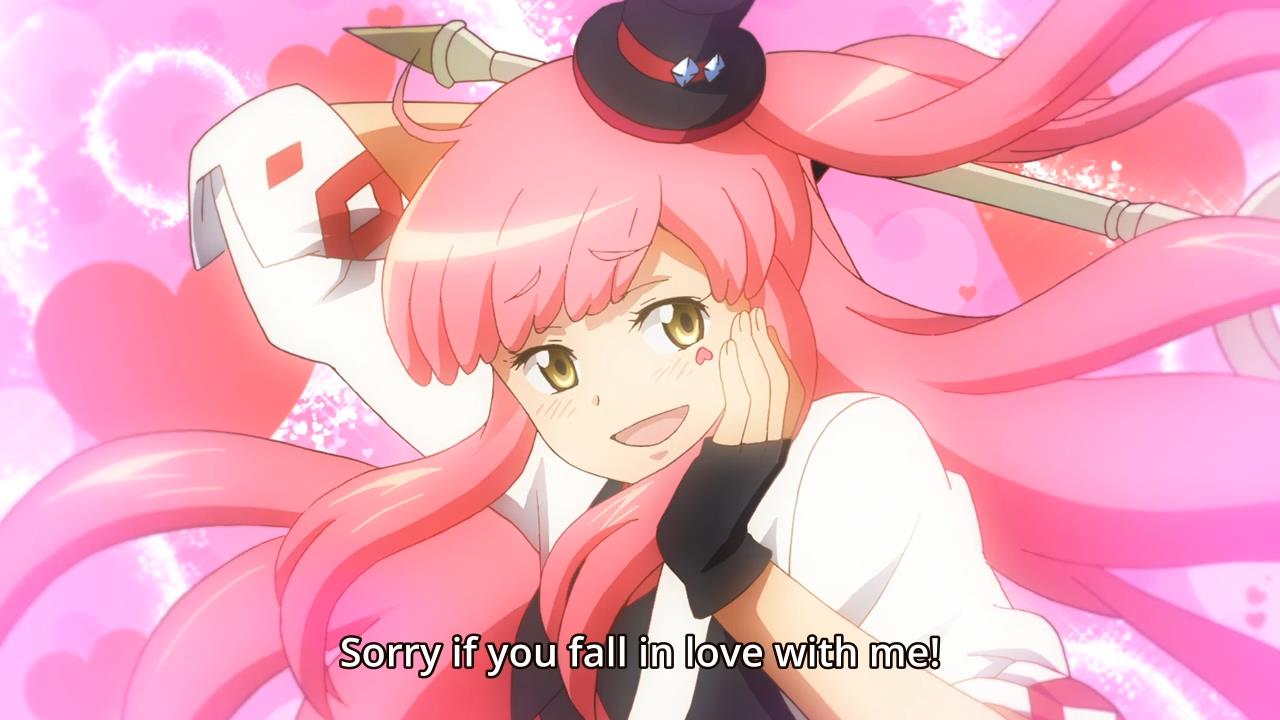
I have very, very strange feelings about these first two episodes. On paper, they did a bunch of the standard things mecha shows like this tend to. We started off with an upbeat, overachieving protagonist, Bellri, out on a space elevator ride when a space pirate attacks. Bellri uses his training suit to defeat the pirate, his superiors capture her familiar-looking mobile suit, and Bellri is immediately starstruck by the dashing pirate lady. Then in the second episode, the ostensible pirate’s teammates attempt to free her from Bellri’s academy-slash-military-base, and Bellri this time ends up using her mobile suit to fight off the attackers. Throw in a mysterious amnesiac girl, a few school buddies, some scattered adults, and you’ve got all the ingredients for a standard mecha drama. But it’s really the way those pieces came together, or didn’t, that both intrigued and distanced me here.
Fall 2014 – Virtually Every First Episode Retrospective
I have been very busy these last couple weekends! Working on the ANN preview guide has meant I’ve had to watch and write about virtually every full-length show that premiered this fall – I believe the only ones we missed were G Reco, Amagi Brilliant Park, and Seven Deadly Sins, and I actually wrote about the first one and took notes on the second anyway. Of course, since all that was for ANN, you guys over here haven’t had heard as much from me. So in light of that, I’ve decided to do a hyper-speed mega-Week in Review rundown of my most summarized thoughts on every goddamn show, complete with links to individual ANN pages where you can find the small essays I wrote on every single one of them. If you want to hear me praise stuff, stick to the top, if you want to hear me tear shit apart, check out the bottom. There’s been a wide, wide range of shows this season, and every one of them has earned a whole bunch of words. LET’S DO THIS.
Fall 2014 – First Episode Reflections, Part Three
I WOULD LIKE TO GET OFF THIS RIDE NOW PLEASE. Since my last post, I’ve checked out Parasyte, Daitoshokan no Hitsujitai, Chaika: Avenging Battle, Garo the Animation, Shirobako, Psycho-Pass 2, Your lie in April, and How The Fuck Did They Approve a Show That’s Basically Just One Joke About Twintails. You can check out episodic posts about every single one of these shows on ANN.
Of this group, I strongly recommend Parasyte and Shirobako, also enjoyed Garo and Your lie in April, and was perfectly content with both the Chaika and Psycho-Pass sequels. Daitoshokan and Twintails have essentially no reason for existing, and their continued existence in spite of this is baffling and faintly disturbing. So yeah, Of these eight shows, I actually solidly enjoyed six of them – I’m pretty happy with that ratio!

Fall 2014 – First Episode Reflections, Part Two
The ride NEVER EVER ENDS. I have watched a truly madness-inducing quantity of anime, and the fruits of my labors are here for you. Since the last update, I’ve put up first episode reviews for In Search of the Lost Future, Fate/stay night, World Trigger, CROSS ANGE, Wolf Girl and Black Prince, Celestial Method, Rage of Bahamut: Genesis, The Fruit of Grisaia, Gugure! Kokkuri-san, When Supernatural Battles Became Commonplace, Laughing Under the Clouds, Akatsuki no Yona, and Trinity Seven. That is way too much goddamn anime.
Of that formidable list, the only shows I’d actually recommend for everyone are Fate/stay night and Rage of Bahamut: Genesis. More genre-specific fare would Celestial Method, Gugure! Kokkuri-san, When Supernatural Battles Became Commonplace, and The Fruit of Grisaia. That is, if you like feelsy dramas, 4koma comedies, Haruhi-style club shows, or nicely animated drama/harem-things, those would be my choices respectively. EVERYTHING ELSE WAS PAIN. Nah, just Cross Ange, but seriously – way too much anime. Fortunately, my next update should be more proportionally positive. I’ll let you know!

Sword Art Online II – Episode 14
Sorry I didn’t post this on Saturday! I’ve been absolutely buried in previews the last couple days, which I’ll link again later – so far, I’ve watched and written about fifteen new shows, including two double-length episodes, and all but two of those shows came out over the last three days. So it’s been a time! I’m also putting the finishing touches on a Zankyou no Terror piece, so that should also be in the near future, as well as my first ANN full show review.
Anyway! I actually really liked the conclusion to the GGO arc. It wrapped up both the themes and characters with a great deal of thoughtfulness and a lack of melodramatics. Nice to see SAO doing good.

Fall 2014 – First Episode Reflections
The fall season has begun! For you guys, that probably means checking out what everyone else is watching, catching some sample episodes, and maybe sticking with whatever you were already planning on watching. For me, that means watching the first episode of every single goddamn show. Posts are already up for Terra Formars, Tribe Cool Crew, DENKI-GAI, Log Horizon 2, and Lord Marksman and Vanadis (my real-person name is Nick Creamer, incidentally). The preview guide will continue to be updated over the next week and a half or so as all the various shows premier, so feel free to check back and get my first impressions on basically every full-length show that isn’t a sequel to something I never watched. It’ll be fun! IT’LL BE FUN.
Shounen Hollywood – Episode 13
Holy shit, this show got a second season! Really wasn’t expecting that, but I guess it’s just another indication that whatever’s popular or recognized over here doesn’t mean a good goddamn for sales in Japan. Happy to hear about it, and happy to see the first season go out on a solid note. Until we meet again, ShoHari.
Incidentally, I don’t think there’ll be a Week in Review post this week, mainly because every single episode I’m watching/have watched is either already covered in a full episodic post or will be covered in the insane ANN preview guide. I’ll let you know what those posts start going up!
Barakamon – Episode 12
Barakamon’s ending is a little messier and less graceful than I’d hoped, but it still hits all the notes it needed to hit. A reasonable ending to one of this summer’s best shows.
