
Hello folks, and welcome back to Wrong Every Time. After the overstuffed summer anime season, it seems like we’re in for a quiet one this fall, with seemingly just the return of Apothecary Diaries to look forward to. That suits me just fine though, as I’ve still gotta catch up on a fair number of outstanding seasonal productions, as well as sneak in whatever films I can before year’s end. Regardless, it’s already certain my “new to me” segment of the year in review is going to be absolutely stacked – between the pile of OVAs I’ve screened and highlights like Future Boy Conan, Dirty Pair, and Galaxy Express 999, this has been an exceedingly fruitful year for delving the depths of anime history. I’m still figuring out what legacy project I’ll tackle next, but for now, let’s run down the week in films!
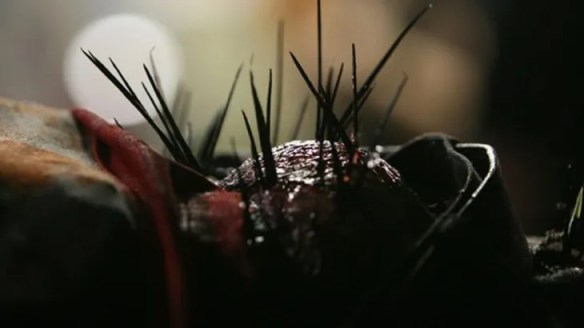
First up this week was Splinter, an ‘08 horror feature centered on a young couple who find themselves taken hostage by a pair of strangers, only for the whole crew to end up trapped in a gas station by the emergence of some zombie-like infection. Upon being pricked by any infected individuals’ emergent quills or “splinters,” the target swiftly loses control of their own body, and is forced to serve as the mutated carrier of a horrifying parasite.
Splinter offers a lean eighty minute siege against a truly diabolical creation, a “monster” whose emphasis on skin-piercing slivers and grotesque bodily contortions makes for some wonderfully queasy highlights. Much like in the Dead Space franchise, this infection’s lack of understanding for how human anatomy works provides a great part of its appeal – rather than exploiting our existing bone structure and musculature, this parasite swerves and snaps limbs in whichever direction it wishes, making for uniquely uncanny monsters and plentiful half-infected body horror.
The film’s modest means are clear in its narrow focus, as well as its reliance on shaky cam to obscure the limitations of its practical horror effects. That said, there’s an inherent appeal in seeing limited funds stretched across a clear passion project, and the cast’s increasing mutual trust and progression of tactical gambits make for enough variety to keep things engaging. If you’re enticed by the thought of a scrappy creature feature falling somewhere between Tremors and Green Room, I’d give it a shot.
We then screened Charade, a ‘63 mystery-thriller-romcom starring Audrey Hepburn as the widow of a man who apparently stole a fortune in gold during the second World War, and Cary Grant as the disarming stranger who agrees to help her find it. Along the way, they must contend with the persistent threat of three of her husband’s co-conspirators, while also managing the demands of the equally interested CIA, and also maybe falling in love.
Charade is an absolute goddamn delight of a film, soaring on the strength of its playful, witty screenplay and the easy chemistry of its dynamite leads. Cary Grant has long been my favorite of Hollywood’s golden age leads, possessing an inherently self-effacing manner and mastery of physical comedy that makes him seem like a living cartoon character. He’s not quite as limber here as back in his Bringing Up Baby/His Girl Friday years, but he’s still a dazzlingly charismatic presence, and ably matched by Hepburn. She essentially plays the straight man here, snuffing Grant’s outbursts with a cool, deadpan wit that naturally compliments her role as a fish out of water who’s swiftly learning to swim with the best of them.
Given such capable leads and dialogue so worthy of them, it almost feels unfair that Charade also impresses as a traditional thriller, boasting tense faceoffs and Hitchcockian chase scenes and endless cheeky twists. Every time Hepburn gets too comfortable assuming she’s in a romantic comedy, some menacing figure or another phones her up with new doubts about Grant’s identity, equipping the film with the delirious pacing and rampant confusion of the best whirlwind romances. Smart, hilarious, and brimming with thrills, Charade offers a perfect union of talent and material, an utterly elevated apportioning of feel-good entertainment.

We then screened the beloved OVA-era artifact Project A-ko. Originally intended for inclusion in the Cream Lemon series of pornographic features, the film was instead spun off into a more traditional action-adventure direction, while admittedly still being festooned with a truly formidable number of panty shots. Its vague plot concerns superpowered schoolgirl A-ko attempting to protect her best friend C-ko from the entreaties of rival B-ko, all while some sort of alien invasion rages in the background.
Project A-ko is essentially a loosely constructed assemblage of things the animators like, namely: school girls, fight scenes, and exploding space ships. The film barely bothers to connect these core fascinations, instead mostly engaging in Rumiko Takahashi-adjacent action-comedy shenanigans, as A-ko continuously demolishes the schemes of B-ko in order to protect C-ko.
The care placed in naming these central characters should give you some indication of the film’s attitude towards storytelling; they’re simply goofy archetypes, and the film has a great time smashing them against each other, ultimately leading to a high-flying finale where they continue to bicker while also demolishing a massive Star Destroyer-reminiscent spaceship, whose bridge is a model of the Space Battleship Yamato and whose captain is clearly just Captain Harlock. Nothing that will stick in the mind, but if you’re looking for an inane slice of action-comedy (with admittedly far superior action to comedy), you could do a whole lot worse.

Last up for the week was Robot Jox, a ‘90 scifi feature by beloved B-horror director Stuart Gordon (Re-animator, From Beyond). Gary Graham stars as Achilles – one of the titular Robot Jox, pilots of massive bipedal robots that compete in duels to decide global territory disputes by proxy. With only one match left before he is released from his contract, Achilles must juggle his desire for freedom, his grudge with Confederation (basically the Soviet Union) pilot Alexander, and his complicated feelings for his genetically engineered successor Athena.
Robot Jox is messy, anachronistic, and altogether charming. Its Cold War theming likely already felt dated by its release date (the film was originally shot in ‘87), and its dialogue is a messy mixture of action cliches and military jargon, but its post-apocalyptic setting actually feels quite relevant to modern social degradation, as geopolitics is reframed as sport in order to distract from our fraying social contract.
I quite liked the film’s clean, desolate set design; Gordon rarely works with much of a budget, so it was gratifying to see him given the chance to realize a full-on capitalist apocalypse. With a few more scenes digging into the daily experience of life in “The Market” (the film’s well-chosen pseudonym for America), Robot Jox would likely possess the emotional bite to stand as a genuine cult classic. As is, I can at least highly recommend its scenes of robot mayhem, which offer delightful and satisfyingly weighted stop-motion action.
