
Hello folks, and welcome back to Wrong Every Time. This week has seen me juggling multiple productions in my race through the year’s outstanding anime, with my apartment diligently munching through both A Hundred Scenes of Awajima and Sparks of Tomorrow. The first has proven an absolutely staggering experience, pairing one of Madhouse’s greatest directors with one of the most wide-ranging and emotionally acute stories of recent years. From its tender illustration of the lies we tell each other to its stark, generation-hopping dramatic scope, Awajima is proving a poignant and insightful drama on all fronts. Meanwhile, in spite of its high-concept premise, Sparks of Tomorrow is falling more in that comic fantasy KyoAni mode of shows like Beyond the Boundary or Phantom World; it’s less ambitious or intelligent than I’d like, but remains visually compelling and generally watchable. I’ll hopefully have both shows tidied up by next week, but for now, let’s run down in the week in film!
First up this week was the ‘53 scifi horror feature Invaders from Mars. The film centers on David MacLean (Jimmy Hunt), a young boy who one night witnesses the crash of a flying saucer through his bedroom telescope. When his father goes to investigate, he returns with a brusque and violent new personality; as others visit the site, they also seem ominously changed by the experience. With his friends and family so altered, David must race against time to inform the authorities before they too are swallowed by this mysterious threat.
Invaders from Mars is one of the great tentpoles of ‘50s scifi, beloved by luminaries ranging from Scorsese to Spielberg, and directed by the alleged “father of production design” William Cameron Menzies. The production and color design of the feature is indeed excellent, though I suspect much of its significance is still lost on me, and simply folded into the visual assumptions of all the great artists who would come after Menzies. That said, the story itself is equally iconic, presenting a Salem’s Lot-esque tale of alien invaders slowly replacing a human community.
The film leans heavily on the soundstage depicting the wooded path leading to the aliens’ trap, and for good reason; it’s a vivid and ominous set, presenting the loss of your humanity as just a short trip down the lane, like you’ve stumbled past the forest’s edge and been whisked off by the fairies. There’s something dreadful and ineffable about that repeated image, all the more so because it doesn’t present any overt signs of danger – like a Yellow Brick Road guiding the unwary into the maw of some terrible organism. I was also surprised and impressed by how effectively the film escalated the scale of its drama, successfully transitioning from the anxious, vulnerable perspective of its original boy protagonist to a sprawling action drama involving tank battalions and frantic flights through alien-carved underground tunnels. A film that impresses at every turn, offering generous flourishes of horror and adventure, and clearly setting the template for its admirers’ further features.

We then checked out The Bad Guys 2, the sequel to the 2022 feature centered on a group of animal heist specialists. Well, former heist specialists at this point, as the events of the first film have compelled them to collectively turn a new leaf, and become law-abiding members of society. After some time spent wallowing in the indignity of life on the straight and narrow, our crew are pulled back into action with the appearance of a new heisting trio, who seem determined to frame our heroes for their own nefarious deeds.
We are firmly in a post-Spiderverse world at this point, with films like the original Bad Guys and The Mitchells vs The Machines demonstrating a strong, traditional animation-derivative approach to CG art design. The Bad Guys 2 continues this compelling blend of low-frame mimicry and stretchy aesthetic flourishes, while also offering a propulsive adventure that avoids the worst “that’s what I wanted you to think” anti-narrative excesses intrinsic to the heist genre. There’s a thread here of something genuinely impactful, a reflection on society’s superficial aesthetic judgments and refusal to accept the idea of moral reform, but the film sadly never goes further with the concept than letting it serve as thematic window dressing for the first act. What that leaves us with is simply a charming and character-rich animated heist, which I suppose isn’t the worst place to be.

We then continued our journey through the classic kaiju features with The War of the Gargantuas. In this one, Japan comes under attack from a colossal green humanoid that seems to emerge from the sea. Fortunately, humanity has their own homegrown Frankenstein monster, this one with a much gentler disposition and a fondness for the mountains. After a fair amount of rampaging and bickering amongst army officials, the two creatures come to violent blows, Our Buddy Frankenstein aided in his quest by a whole slew of military laser beams.
Gargantuas is a sturdy feature from right in the genre’s golden age, with original Godzilla director Ishirō Honda doing an excellent job of mixing supersized rampages and small-scale human drama. With our gargantuan stars basically just wearing monkey costumes rather than immobilizing rubber suits, the picture inevitably draws some influences from King Kong; rather than simply stomping over buildings, our monster can actually grab individual people, leading to some particularly tense exchanges. Additionally, these flexible costumes facilitate some genuine wrestling exchanges between our two stars, adding some novel dynamics to their big bouts. Not exactly a revelation of a film, but clearly a sturdy step in the evolution of kaiju theater, and a welcome reminder that this genre is still full of pleasures even if I’ve already screened all of the Big G’s adventures.

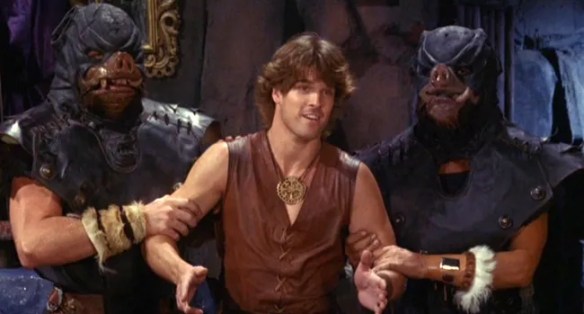
We then returned to the Corman treasure trove with Deathstalker II, the last of his ‘80s Argentinian fantasy productions. In spite of its alleged sequel status, Deathstalker II does away with both the narrative and tone of its predecessor, styling itself as a self-aware riff on the sword and sorcery genre. John Terlesky subs in as our new Deathstalker, who must join forces with a deposed princess in order to strike back and defeat her evil clone.
For this final production, Corman sent down director Jim Wynorski, who had recently helmed the genuinely excellent Chopping Mall. Wynorski’s presence appears to have made all the difference here; faced with decaying sets and an equally hoary script, Wynorski chose to rewrite the film into a comedy, hoping to at least have some fun at the sword and sorcery genre’s expense.
The gambit works surprisingly well. Subbing a genuinely terrible Corman script for an obvious yet functional parodic one significantly raises the professionalism of the feature, and John Terlesky does a fine job as the roguish, charmingly pompous Deathstalker. Wynorski also knows how to shoot an action scene, something that basically none of his predecessors could manage, meaning this film’s dramatic highlights actually possess a touch of whimsy and momentum. It’s not Errol Flynn, but it’s frankly not that far removed; congrats Corman, your buds finally made a real movie.
I found Sparks of Tomorrow to be one of KyoAni’s worst shows since Phantom World funny enough. And from what I heard, the original novel this was based on, that KyoAni published as a book contest winner, was drastically different from what’s on screen. For one thing, it actually has the ambition and social commentary (the clash between tradition and modernity, science vs religion, capitalism vs progress, etc) that this in-name-only adaptation is severely lacking in, which the author even pointed out in their criticisms. Yosuke for one thing is not the poor ADAM knock-off that he ended up as here and I hated his motivation as well.
https://www.youtube.com/watch?v=N7HVXjORQFA I lament what we could’ve gotten instead from watching a 2021 commercial advertising the book.